This time, we'll introduce the Chariot SAMBA, a solar power generation system that uses a mobile battery.
What do you do when you want to charge your smartphone at a place where 100-volt power isn't available, like a campsite? Do you charge a mobile battery and take it with you? Wouldn't it be convenient to have a system that could generate power at the campsite? Let's introduce some campsite power generation systems.
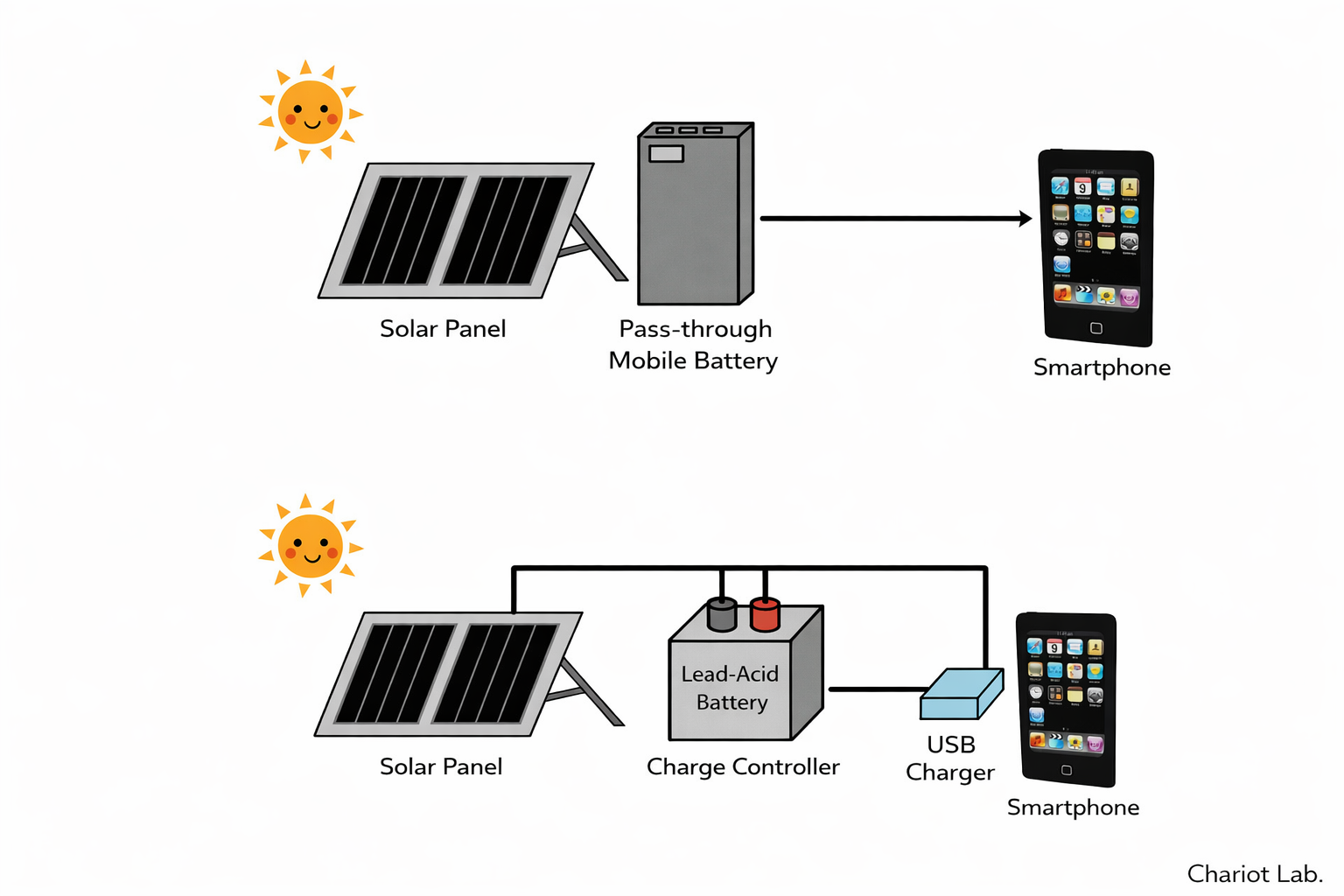
First, there's the standard independent power system that uses a lead-acid battery. When the power generated by the solar panel is greater than the power needed to charge the smartphone, or when there's sunlight and the smartphone is not connected, the lead-acid battery charges the smartphone. When the power needed to charge the smartphone is greater than the power generated by the solar panel, or when the smartphone is being charged at night, the lead-acid battery recharges the discharged smartphone. This system can handle a large amount of power. However, lead-acid batteries are heavy, weighing around 10 kg. They're difficult to carry around.
Next, we'll introduce a method that connects a solar cell to a mobile battery that supports pass-through functionality and charges the smartphone from that mobile battery. This method is very simple and lightweight. However, if a pass-through-compatible mobile battery simultaneously receives power from a solar panel and supplies it to a smartphone, the smartphone's power supply will be around 0.5 amps. In other words, charging will be slow.
That's where Chariot Samba comes in. Chariot Samba has three power receiving paths: from the mobile battery to the smartphone, from the solar panel to the smartphone, and from the solar panel to the mobile battery. Each path can charge at around 1.5 amps.
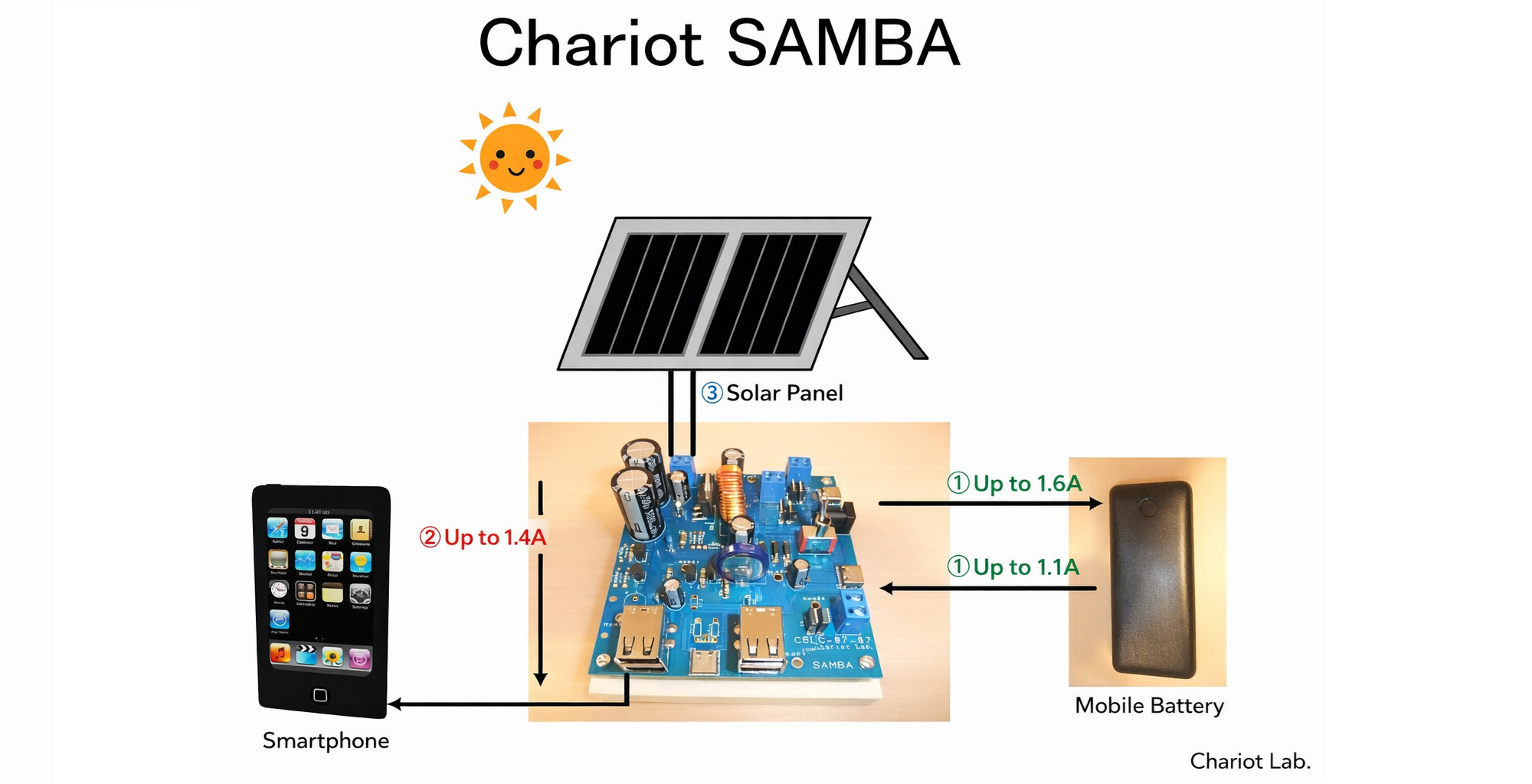
When the sun is strong and the power generated by the solar panel exceeds the power needed to charge the smartphone, the smartphone is prioritized, and the excess power is charged to the mobile battery. The smartphone and mobile battery can charge up to 3 amps combined. When the sun is weak and the power needed to charge the smartphone exceeds the power generated by the solar panel, all power from the solar panel is used to charge the smartphone, and the remaining power is charged from the mobile battery. The combined power from both the solar panel and the mobile battery usually charges at over 1 amp.
This shows the relationship between the power generated by the solar cell and the charging current for each path. Up to about 10 watts of power generated by the solar cell, the solar panel and mobile battery work together to charge the smartphone. The lower the amount of power generated by the solar cell, the more power the mobile battery supplies. The higher the amount of power generated by the solar cell, the more power the solar cell supplies. Above about 10 watts, all power charged to the smartphone is generated by the solar cell, with the surplus power charging the mobile battery.
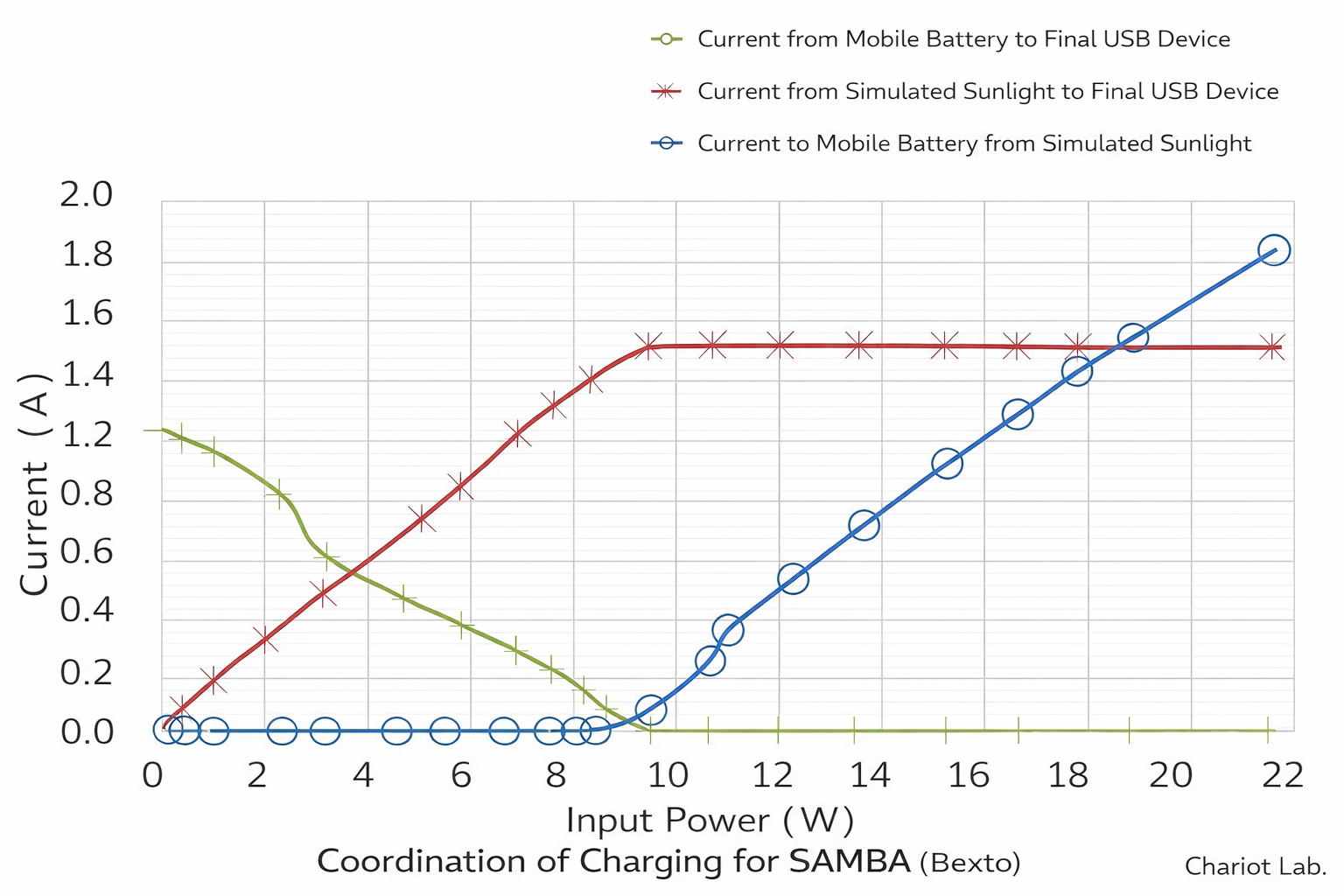
It is significantly lighter than lead-acid batteries and charges smartphones faster than systems using only a mobile battery with a solar cell pass-through function.